Thank you! Your submission has been received!
Oops! Something went wrong while submitting the form.

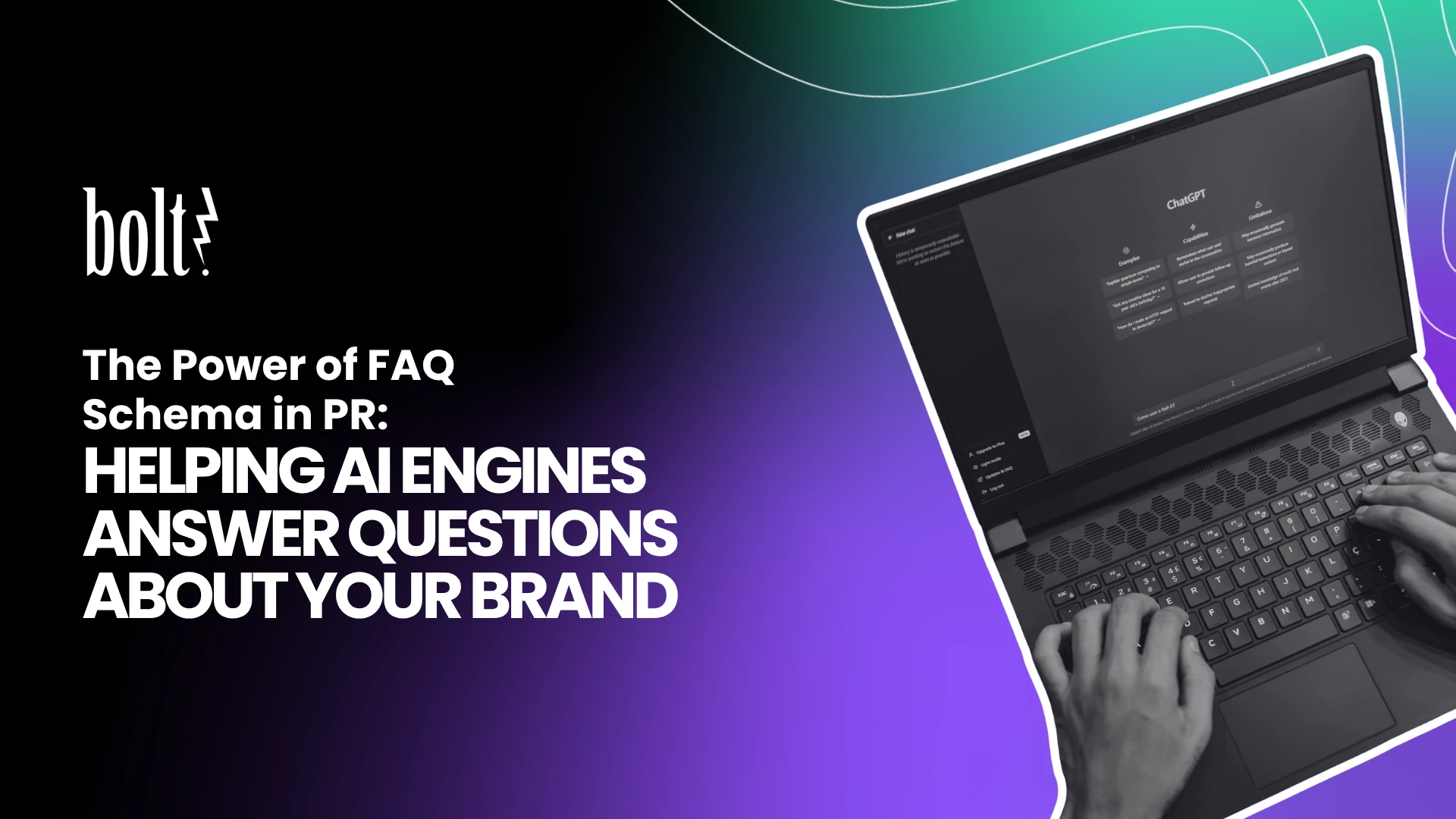
Public relations is the art of shaping a narrative, building credibility, and ensuring that when people ask questions about a brand, they receive the right answers. For decades, those answers came from trusted journalists, industry analysts, and word of mouth. Today, a new and highly influential voice is answering those questions: artificial intelligence.
As search engines evolve into conversational answer engines, the way brands approach digital visibility must adapt. It is no longer enough to simply rank on a search engine results page. Brands must now ensure their narratives are clearly understood, extracted, and cited by AI models. This requires a seamless blend of strategic communication and technical precision. One of the most powerful, yet often overlooked, tools in this modern PR toolkit is FAQ schema.
Understanding how to leverage FAQ schema opens the door to Answer Engine Optimization (AEO) and Generative Engine Optimization (GEO). Bolt partners with forward-thinking brands to ensure that compelling narratives translate perfectly into the structured data that AI systems crave.
To grasp the power of FAQ schema, it is important to understand the three layers of digital search in 2026. These are not competing strategies but rather a unified stack that builds upon itself.
1. Search Engine Optimization (SEO): The Foundation
SEO remains the entry ticket to online visibility. It ensures a website is technically sound, easily crawled, and trusted by search indexes. While SEO used to be the entire strategy, it now serves as an important first step. Without a strong SEO foundation, AI systems will struggle to find a brand's content in the first place.
2. Answer Engine Optimization (AEO): Structuring for Extraction
AEO is the practice of structuring content so that AI-powered search features can extract it as a direct answer. This includes Google's AI Overviews, featured snippets, and voice assistants. The goal of AEO is to present information in clear, concise chunks that map cleanly to the formats these engines prefer.
3. Generative Engine Optimization (GEO): The Citation Strategy
GEO is the newest layer of digital visibility. It focuses on getting a brand cited by large language models (LLMs) like ChatGPT, Claude, and Perplexity. In the generative AI era, traditional keyword stuffing is ineffective. Instead, these models look for authoritative language, named entities, expert quotes, and backed statistics to formulate responses.
The shift in user behavior is undeniable. A recent study analyzed 260 billion clickstream events and found that 58.5% of Google searches now end without a click, because users are getting their answers directly on the results page. Recent data also found that Google's AI Overviews appear in over 25% of all searches. The traditional goal of ranking in the top three blue links has evolved into a new objective: getting named inside the AI answer block.
FAQ schema is a form of structured data. It is a piece of code placed on a webpage that explicitly tells search engines and AI crawlers, "This text is a frequently asked question, and this text is the direct answer." Technically known as FAQPage schema within Schema.org, it is typically implemented using JSON-LD format.
While humans can easily read a paragraph and identify the underlying question it answers, machines benefit immensely from explicit labeling. When a brand uses FAQ schema, it removes the guesswork for AI bots. The technology no longer has to interpret the HTML structure or parse lengthy paragraphs to find value. The question and answer are served through schema.
Although Google has reduced the visual appearance of FAQ rich results in standard search to focus primarily on credible government and health sites, the underlying value of the schema remains paramount. Google and other language models still heavily rely on FAQ structured data to understand page context and to generate accurate conversational responses.
In the context of PR, reputation management is priority. When a potential customer, investor, or journalist asks an AI tool about a company's values, product capabilities, or recent controversies, the brand needs to own that narrative.
Here is why FAQ schema is vital for a comprehensive PR strategy:
AI engines prefer content that is already structured as a question followed by a direct answer. By anticipating the questions target audiences are asking and wrapping the responses in FAQ schema, a brand dictates the exact phrasing and context the AI extracts. This ensures that the brand's messaging is the source material for the AI's response, rather than a competitor's blog or an outdated article.
Generative systems favor content that is clearly defined, easy to quote, and consistent. A robust FAQ section that addresses real customer concerns demonstrates transparency and authority. When a brand consistently provides the best, most structured answers in its industry, AI models learn to treat that domain as a highly credible entity. This directly supports the PR goal of positioning executives and brands as industry thought leaders and increasing brand awareness.
Traditional SEO is all about ranking, but AI search is about being cited. LLMs synthesize information from multiple sources and cite their references. Content that is structured cleanly with FAQ schema is inherently more extractable, making it highly "citation-ready". Securing a citation in an AI Overview or a Perplexity response is the modern equivalent of a top-tier media mention. It provides third-party validation and direct visibility to a highly engaged user.
Executing a successful FAQ schema strategy requires more than just guessing what users want to know. It requires a targeted approach that aligns with broader marketing and PR goals. Bolt PR recommends the following best practices for integrating FAQ schema into content development.
Do not invent questions that sound like promotional marketing copy. AI systems ignore decorative FAQs and extract from detailed useful ones. Source actual questions from customer support inquiries, sales objections, community forums, and tools like Google Search Console. A question like "What is your mission statement?" is far less valuable than a specific query like "How does your software integrate with existing supply chain logistics?"
When drafting answers for FAQ schema, brevity and clarity are essential. The sweet spot for AI extraction is a concise, complete answer of roughly 40 to 60 words. The very first sentence should directly answer the question without any conversational filler. If a LLM extracts only that single block of text, the reader should still understand the core message. Provide the direct answer first, and then add one or two sentences of supporting context or constraints.
To boost visibility in generative engine responses, infuse the answers with authoritative signals. Anonymous claims hold little weight. Instead of stating that "many customers see great results", use specific, named figures and data points. Recent research indicates that adding statistics can boost visibility in AI responses by 30%, while including expert quotes increases visibility by approximately 41%. It is recommended to also include named entities, such as industry categories or specific methodologies, within the first few sentences to strengthen entity recognition.
The answers provided within the FAQ schema must perfectly match the visible content on the webpage. If users cannot see the questions on the page, do not mark them up in the code. AI models value consistency, and mismatched data can harm credibility. Always validate the structured data using testing tools to ensure the JSON-LD is correctly formatted before publishing.
Navigating the intersection of storytelling and technical optimization requires a dynamic team. Content strategy is critical, and standing out in an AI-driven landscape requires experts who understand both the art of persuasion and the science of digital visibility.
The shift toward AI search is not just a fad; it is a massive opportunity for brands willing to adapt. By embracing tools like FAQ schema, companies can ensure their stories are told accurately, consistently, and prominently across every new digital platform. It is time to step into the citation economy with confidence.
Bolt focuses on elevating brand expertise through thought leadership, media relations, engaging web copy, and strategic blog content. Bolt understands that a compelling brand narrative is the foundation of all marketing and communications. However, a brilliant narrative only drives impact if it actually reaches the target audience.
Whether it is developing informative white papers, crafting rapid-reaction news strategies, or building comprehensive AEO roadmaps, Bolt bridges the gap between traditional brand storytelling and technical execution.

Not sure where to start?
Contact our team to start the conversation around a customized marketing campaign dedicated to your personalized business goals. From PR to content creation and digital marketing, you tell us how far you want to take your brand, and we’ll do the rest.
We can’t wait to hear from you!





.png)


