Thank you! Your submission has been received!
Oops! Something went wrong while submitting the form.

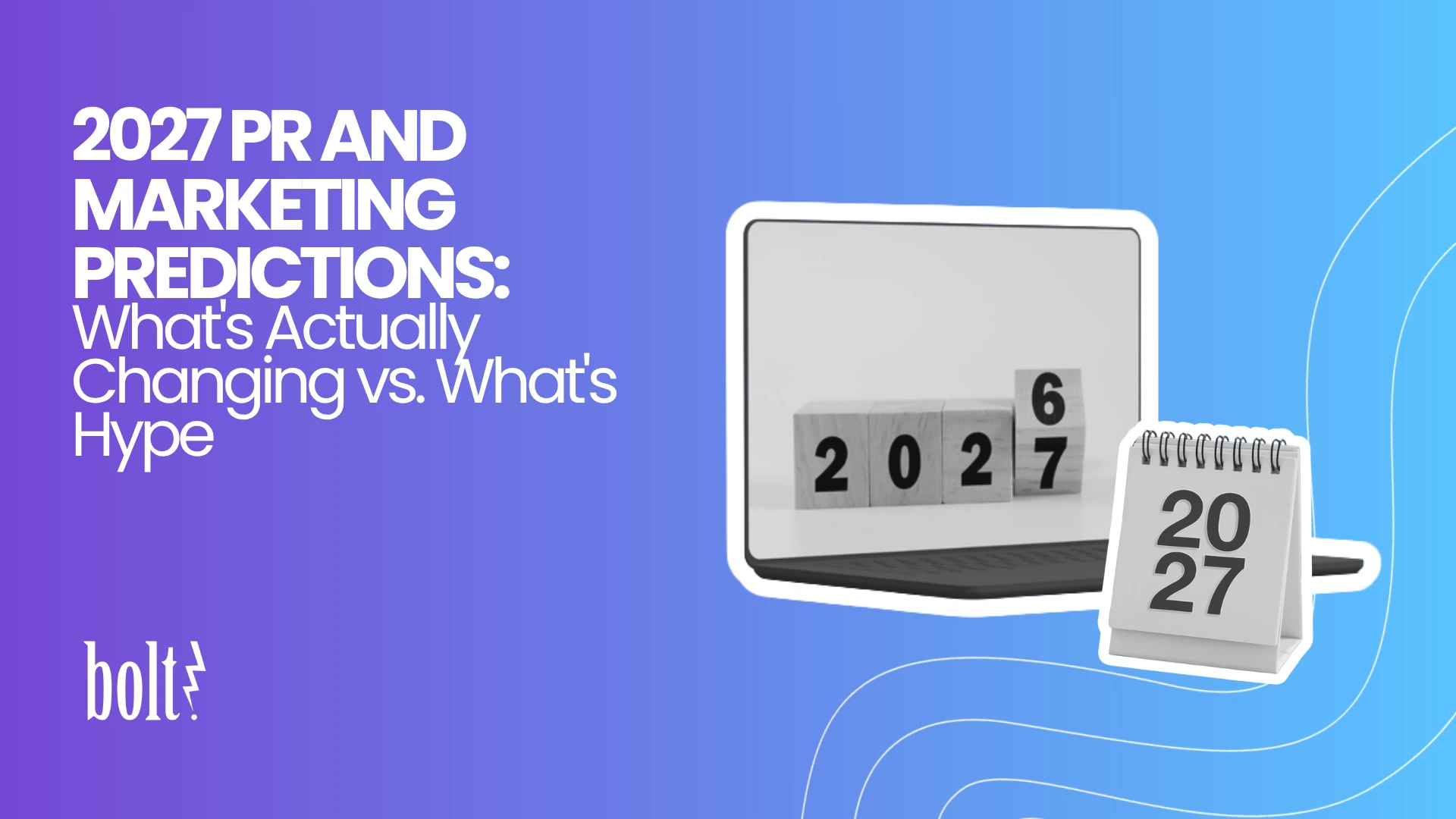
In 2027, successful PR and marketing require balancing AI-driven discovery engines with earned media credibility. Brands win by optimizing for Generative Engine Optimization (GEO), maintaining first-party data ownership, and securing tier-one earned media that AI models train on. Generic content automation and pure influencer vanity metrics are officially obsolete.
In an era flooded with pitch decks declaring AI will replace entire marketing departments, brands are struggling to separate tactical evolution from exaggerated noise. Every headline promises a revolution, yet chief marketing officers and communications directors face the daily reality of fragmenting channels, changing search behaviors, and evolving consumer trust dynamics.
At Bolt PR, strategy is grounded in real-world outcomes rather than industry buzzwords.
This analysis examines 2027 marketing and public relations trends, evaluating what is genuinely driving market performance, what has proved to be empty hype, and how brands can position themselves to lead.
Navigating the modern media ecosystem requires a clear filter. To help communications leaders allocate budget and resources effectively, Bolt PR categorizes the defining industry trends into Structural Reality versus Overhyped Distraction.
Navigating the modern media ecosystem requires a clear filter. To help communications leaders allocate budget and resources effectively, Bolt PR evaluates the defining industry trends across search, content, social, and data privacy.
When examining search and discovery, the common hype claims that SEO is completely dead and that only AI prompts matter. In structural reality, 60.4% of adults use AI for search, but those AI models rely heavily on indexed authoritative web data and earned media. The strategic impact requires brands to shift focus to Generative Engine Optimization (GEO) backed by high-authority earned PR.
Regarding content creation, many hype narratives insist fully autonomous AI will generate 100% of brand content. However, mass AI content creates noise while target audiences prioritize verified human proof, expert quotes, and executive positioning. The strategic impact dictates that human insight must drive brand narratives, while AI scales distribution and analytics.
In social and influencer marketing, the hype suggests mega-influencer follower counts drive sales. In structural reality, vanity follower counts suffer from low engagement, whereas 41.8% of consumers research via social seeking authentic micro-creators. Brands must shift strategy to invest in vetted micro-creators and executive thought leadership programs.
Finally, regarding data and privacy, the hype claims third-party ad tracking is easily replaced by AI algorithms. In structural reality, cookie deprecation makes first-party zero-party data acquisition mandatory for ad performance. Strategic brands must prioritize owned content hubs, newsletters, and interactive brand experiences.
The era of relying solely on ten blue links on Google has officially transformed. According to global digital trend reports, over 3.24 billion people regularly use generative AI tools, and over 60% of online adults rely on conversational AI models to research answers, products, and service providers.
When prospective buyers query an AI answer engine, they are not presented with pages of keyword-stuffed links. They receive synthesized, direct recommendations.
For brands, visibility in 2027 depends on Generative Engine Optimization (GEO). AI models synthesize answers by querying third-party coverage, authoritative industry databases, digital press releases, and structured website data. If a brand lacks a strong footprint in respected media outlets, AI search engines will omit it from generated answers.
To help brands adapt, Bolt PR integrates earned media relations directly with digital content strategies. For instance, when working with Brinks Home, Bolt PR executed an integrated campaign that secured over 150 earned media placements across top consumer and trade outlets, including Forbes, Bob Vila, NBC News, Security Systems News, and SDM Magazine. By positioning company executives as trusted industry experts on smart home innovation and security, Bolt PR established a verified media footprint that continues to power the brand's visibility across both traditional search and AI engine queries.
Understanding the fundamental shift from traditional SEO to GEO is essential for modern communications strategy:
A common misstep in 2027 planning is assuming that press releases and earned media relations are losing relevance. In reality, earned media has become more valuable than ever.
Large Language Models (LLMs) and generative discovery tools are programmed to prioritize verified, non-hallucinatory facts. They weight published editorial content from recognized trade journals and national publications higher than self-published corporate blogs.
When Bolt PR represented display technology provider BenQ, the team activated targeted press briefings during major industry showcases, securing features for flagship releases like the 48-inch MOBIUZ EX480UZ gaming monitor. That tier-one coverage established persistent entity authority that digital discovery engines continue to pull from today.
PR in 2027 isn't just about securing headlines for humans to read; it's about building the permanent knowledge graph that AI algorithms rely on to recommend industry leaders.
The Hype: Marketing departments can replace human strategists and writers with autonomous AI tools to generate thousands of articles per month automatically.
The Reality: Search engines and AI discovery tools actively de-prioritize repetitive, synthetic content. As overall web traffic has shifted and refined, audiences ignore generic articles. High-converting content requires proprietary data, original interview quotes, real-world case studies, and verified corporate news. AI serves as a powerful research assistant, but human expertise drives strategy, tone, and brand safety.
The Hype: C-suite executives can delegate 100% of their thought leadership to fully automated social posts and corporate speak without personal involvement.
The Reality: Decision-makers connect with leaders, not corporate logos. During major corporate shifts, such as Brinks Home relocating to a 27,000-square-foot headquarters and transitioning to a hybrid work model, Bolt PR framed the news around executive vision and workplace innovation. Securing strategic coverage across business outlets like Dallas Morning News, Dallas Business Journal, and Security Today required articulating genuine leadership philosophies. Authentic human positioning builds corporate equity that automated campaigns cannot duplicate.
The Hype: Paying six-figure fees to macro-influencers with millions of passive followers delivers guaranteed ROI.
The Reality: Conversion data shows that audience size does not equal consumer action. In 2027, micro-creators and niche subject matter experts drive higher conversion rates because their communities trust their recommendations. Modern influencer marketing requires careful vetting, authentic brand alignment, and integration with broader PR messaging.
To capture market share in 2027, marketing leaders must align earned media, digital content, and AI optimization into a unified framework.
Allocating resources effectively depends on company size, market maturity, and growth targets. Below is how Bolt PR recommends structuring monthly PR and digital marketing investments in 2027:
Trade show environments highlight the importance of an integrated PR strategy. Planning for major events like CES 2027 in Las Vegas (January 6–9, 2027) requires establishing media touchpoints months before the show floor opens. Bolt PR refreshes each trade show communications program annually, starting approximately 10 weeks prior to event opening.
Executing a high-impact presence at CES 2027 follows a disciplined timeline:
During previous CES activations, Bolt PR managed on-site media relations for technology innovators across consumer tech, healthtech, and display sectors. For example, when CarePredict introduced its AI-powered digital health wearable for senior care at CES, Bolt PR secured targeted broadcast and healthtech trade interviews that demonstrated product utility to buyers and investors.
By securing pre-show embargoed briefings, coordinating on-site booth interviews, and submitting for industry awards, brands can ensure their trade show investments deliver lasting media coverage and ongoing search visibility.
As brand discovery shifts toward conversational AI and search engines continue to reward authentic human proof, marketing and communications leaders must avoid split-budget distractions. B2B, B2C, and franchise organizations that succeed in 2027 will do so by combining structured digital optimization with high-impact earned media, expert executive positioning, and authentic community engagement.
Building entity authority is a cumulative process. By grounding strategy in verified press coverage and structured data assets, brands ensure they remain top of mind for human decision-makers and AI recommendation models alike.
Traditional SEO focuses on ranking web pages on search engine result pages for specific keyword phrases. GEO optimizes brand mentions, authoritative press coverage, structured data, and expert insights so AI answer engines (such as ChatGPT, Claude, Perplexity, and Google AI Overviews) synthesize and cite your brand as the primary, trusted answer.
Earned media relations remains a vital component of modern communications. AI discovery engines actively rely on trusted third-party news outlets, regional business publications, and industry trade journals to verify brand authority. Securing coverage in respected publications provides direct credibility with human readers while building the digital citations required for AI visibility.
AI is best used as an operational tool for data analysis, media monitoring, and initial content research. Strategic narrative creation, crisis management, executive positioning, and pitching journalists require human judgment, relationship building, and nuanced storytelling.

Not sure where to start?
Contact our team to start the conversation around a customized marketing campaign dedicated to your personalized business goals. From PR to content creation and digital marketing, you tell us how far you want to take your brand, and we’ll do the rest.
We can’t wait to hear from you!