Thank you! Your submission has been received!
Oops! Something went wrong while submitting the form.

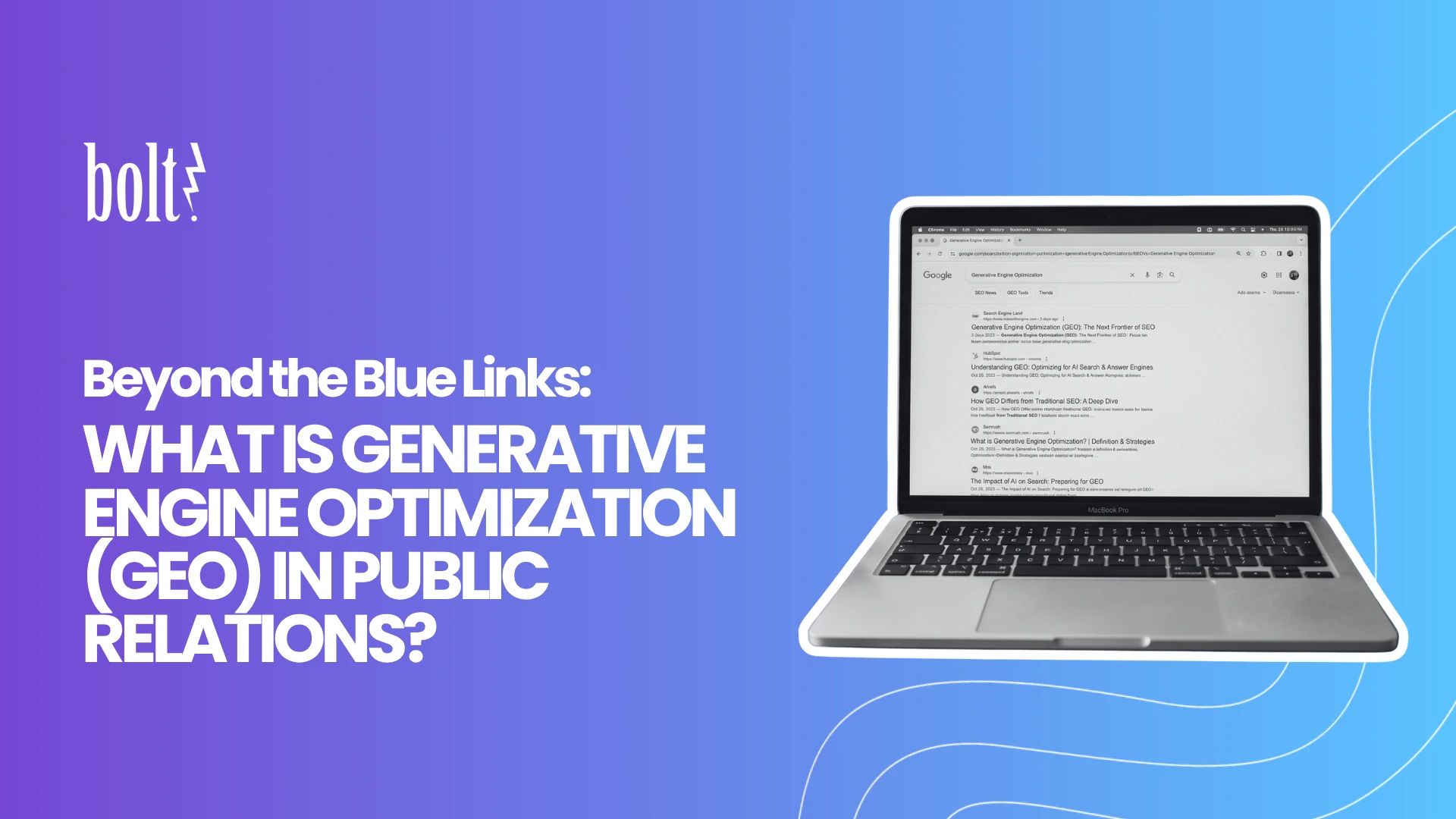
The digital sandbox has officially shifted. For decades, public relations and search engine optimization (SEO) operated in a well-understood loop: PR secured high-authority media placements, and SEO optimized on-page keywords to help brands climb the "ten blue links" of traditional search results.
Today, consumer habits look entirely different. With conversational platforms answering queries directly, the race is no longer just about ranking at the top of a page. It is about becoming the trusted source that an artificial intelligence model cites in its answer.
This evolution is driven by Generative Engine Optimization (GEO), a communication framework focused on structuring, writing, and distributing content so that large language models (LLMs) select and credit your brand. At Bolt PR, we recognize that GEO is not a replacement for traditional visibility, but a crucial layer that turns brand authority into algorithmic trust.
Here is an educational guide on what GEO means for the PR landscape and how brands can adapt.
To understand GEO, it helps to look at how it diverges from traditional SEO in scope and outcome:
The term was formalized by researchers at Princeton University, Georgia Tech, and IIT Delhi, who demonstrated that specific optimization techniques could boost a brand's visibility in AI responses by up to 40%.
As search engines shift toward direct answers, traditional click-through rates are facing downward pressure. Data indicates that zero-click searches have climbed significantly since the rollout of AI-driven search features. For brands, this means that if your audience consumes information inside an AI interface without ever clicking through to a website, your brand must be the one named and cited within that chat bubble.
Many marketers assume that optimizing for AI is a purely technical task. However, the architecture of generative engines makes public relations more valuable than ever.
AI models like ChatGPT, Perplexity, and Google Gemini do not just match keywords; they evaluate entity relationships, context, and credibility. When deciding which companies to recommend, these systems rely heavily on third-party validation. According to a recent AI brand visibility index, up to 82% of AI citations originate from earned media channels, while a mere 6% come from paid or owned platforms.
Because public relations specializes in securing authoritative editorial coverage, expert commentary, and trusted industry reviews, a strong PR footprint serves as the foundational training data and real-time retrieval source that AI platforms trust most.
To ensure your communications strategy is optimized for generative search, Bolt recommends focusing on three core content adjustments:
While GEO measurement is still maturing, brands can track success by monitoring direct referral traffic from AI domains in Google Analytics, conducting manual citation audits for target industry queries, tracking unlinked brand mentions, and utilizing emerging third-party AI monitoring tools that track share of voice within AI overviews.
SEO focuses on optimizing a website to rank within traditional search engine results pages to drive traffic back to a site. GEO focuses on structuring content across the web so that AI search tools and chatbots quote and credit your brand directly within their generated answers, regardless of whether the user clicks a link.
GEO strategies target conversational AI platforms, search-based assistants, and hybrid search features. These include OpenAI's ChatGPT, Perplexity AI, Google Gemini, Google AI Overviews, Anthropic's Claude, and Microsoft Copilot.
AI platforms weigh factors like semantic relevance, source authority, and technical structure. They heavily prioritize third-party validated sources, such as reputable news outlets, academic papers, structured data tables, and comprehensive industry blogs that provide direct, evidence-backed answers.
Yes. Because generative search engines rely on credible external databases to ground their answers, securing high-quality earned media through traditional PR is one of the most effective ways to boost AI visibility. AI tools treat premium editorial mentions as a primary signal of trust.

Not sure where to start?
Contact our team to start the conversation around a customized marketing campaign dedicated to your personalized business goals. From PR to content creation and digital marketing, you tell us how far you want to take your brand, and we’ll do the rest.
We can’t wait to hear from you!





.png)


