Thank you! Your submission has been received!
Oops! Something went wrong while submitting the form.

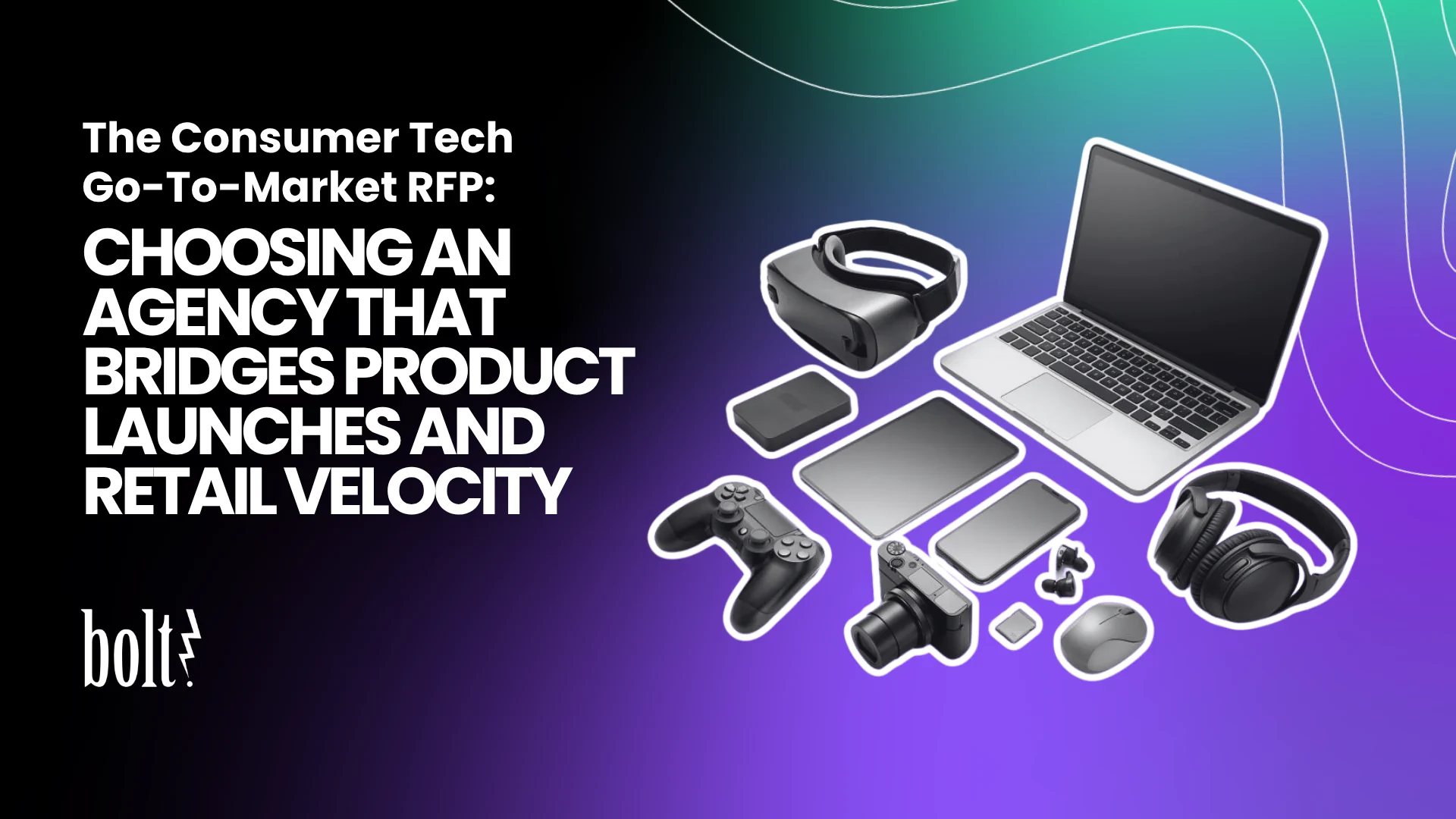
Launching a new consumer tech product is an exhilarating milestone. Yet, too many brands fall into a common trap: they focus entirely on the initial product launch, pouring resources into a single moment of explosive media buzz, only to watch their momentum stall once the product hits retail shelves.
According to market research published by Inc. Magazine, Nielsen’s long-standing benchmark remains true that 85 percent of new products fail, largely due to an integration gap where storytelling infrastructure is missing when the product lands. For hardware brands targeting major players like Best Buy or Amazon, a successful go-to-market (GTM) strategy requires an agency partner that can manage both the initial product drop and the ongoing retail pull.
When drafting your Request for Proposal (RFP), it is crucial to screen for integrated firms that understand how to translate buzz into sustained retail velocity. Here is how to structure your consumer tech RFP to find a partner that bridges this divide.
Most traditional tech PR agencies excel at securing review coverage and launch-day headlines. However, if your retail partners do not see inventory moving within the first 30 to 60 days, your product risks being deprioritized.
Your RFP should explicitly ask agencies how they plan to maintain momentum post-launch. Look for strategic answers that address the full funnel:
In modern retail environments, public relations cannot operate in a silo. A recent Gartner CMO Spend Survey highlighted that marketing budgets remain tight, forcing brands to demand greater efficiency from their agency ecosystems.
The right agency partner treats PR, search engine optimization (SEO), and content as a single, interconnected system. When evaluating RFP responses, prioritize agencies that demonstrate how a major press win will be leveraged to drive retail conversions. For instance, ask how the agency will use high-authority media backlinks to improve your organic search rankings or how they will repurpose earned media coverage into high-performing creative assets for your Amazon Storefront or social media advertising.
The retail landscape has fundamentally shifted with the rise of artificial intelligence. Today, consumers are not just using traditional search engines to find products; they are asking AI platforms like ChatGPT, Copilot, and Gemini for direct shopping recommendations. If an AI tool does not cite your product when a user asks for the "best smart home devices of 2026," you are missing out on a massive revenue pipeline.
To capture this market, your GTM RFP must evaluate an agency's fluency in Generative Engine Optimization (GEO) and Answer Engine Optimization (AEO). Generative engines reward highly authoritative, structured content. Modern PR teams must know how to build LLM-ready (Large Language Model) assets to ensure accurate brand representation and secure coveted AI citations.
When reviewing proposals, prioritize agencies that understand how to map out a clear AI visibility strategy. Your chosen partner should ensure that your earned media wins, executive thought leadership, and technical product specifications function as a single system designed to feed conversational AI algorithms. This dual focus drives immediate sales from human readers while securing long-term discovery across AI shopping assistants.
As you evaluate competing proposals, it is essential to look past polished pitches and identify potential weaknesses. Be sure to pressure-test responses against these common agency pitfalls:
Driving sales at retail giants like Best Buy or Target requires localized agility. Your RFP should look for clear evidence of on-the-ground capability and retail marketing familiarity.
Ask competing agencies to outline a localized pull strategy. A strong response should include plans for regional media tours in top-performing retail markets, strategic partnerships with regional micro-influencers who can film in-store "shopping hauls," and targeted event activations that coincide with major retail seasonal pushes like Back-to-School or the holiday shopping corridor.
At Bolt PR, the team believes that a product launch is just the first chapter of a brand’s commercial story. Bolt PR takes a senior-led, integrated approach that pairs traditional narrative development with digital precision. By blending relentless media relations, digital content strategy, and hyper-local consumer activations, Bolt PR helps hardware brands navigate competitive retail spaces and turn one-time buyers into lifelong brand advocates.
If your brand is preparing for its next major hardware release, structuring your RFP around both launch momentum and retail shelf velocity is the best way to safeguard your investment. By seeking a partner that views public relations through a commercial lens, you can ensure your product does not just land on store shelves, but consistently clears them.
A traditional tech PR RFP focuses heavily on generating immediate media coverage, product reviews, and launch-day buzz. In contrast, a go-to-market (GTM) RFP focuses on business growth and commercial outcomes. It looks beyond launch day to evaluate how an agency will sustain momentum, drive continuous foot traffic to retail stores like Best Buy, and increase digital conversions on platforms like Amazon.
Ideally, you should issue your RFP six to nine months before your target launch date. Finding and onboarding the right integrated partner typically takes two to three months. This timeline allows your selected agency at least three to six months of runway to build digital content, execute pre-launch search and social strategies, and coordinate with retail partners to ensure a successful drop.
You should move past vanity metrics like total impressions. Instead, require agencies to outline how they measure outcomes that impact your bottom line. Look for key performance indicators (KPIs) such as referral traffic from earned media, organic search visibility improvements for high-intent keywords, share of voice against competitors, and retail partnership velocity.
While direct communication with buyers is often handled by your internal sales or broker teams, your agency must understand how those retail ecosystems operate. The ideal agency partner knows how to build marketing campaigns that align with retail compliance, supports promotional calendars, and crafts localized PR pushes that directly influence regional store performance.
When digital advertising platforms restrict reach or become cost-prohibitive, earned media and authoritative owned content become your most valuable assets. Your RFP should pressure-test how an agency intends to use organic tactics, high-authority backlinking, and thought leadership to educate the market, build consumer trust, and de-risk the buying decision for retail shoppers without relying solely on paid ad spend.

Not sure where to start?
Contact our team to start the conversation around a customized marketing campaign dedicated to your personalized business goals. From PR to content creation and digital marketing, you tell us how far you want to take your brand, and we’ll do the rest.
We can’t wait to hear from you!


.png)


