Thank you! Your submission has been received!
Oops! Something went wrong while submitting the form.

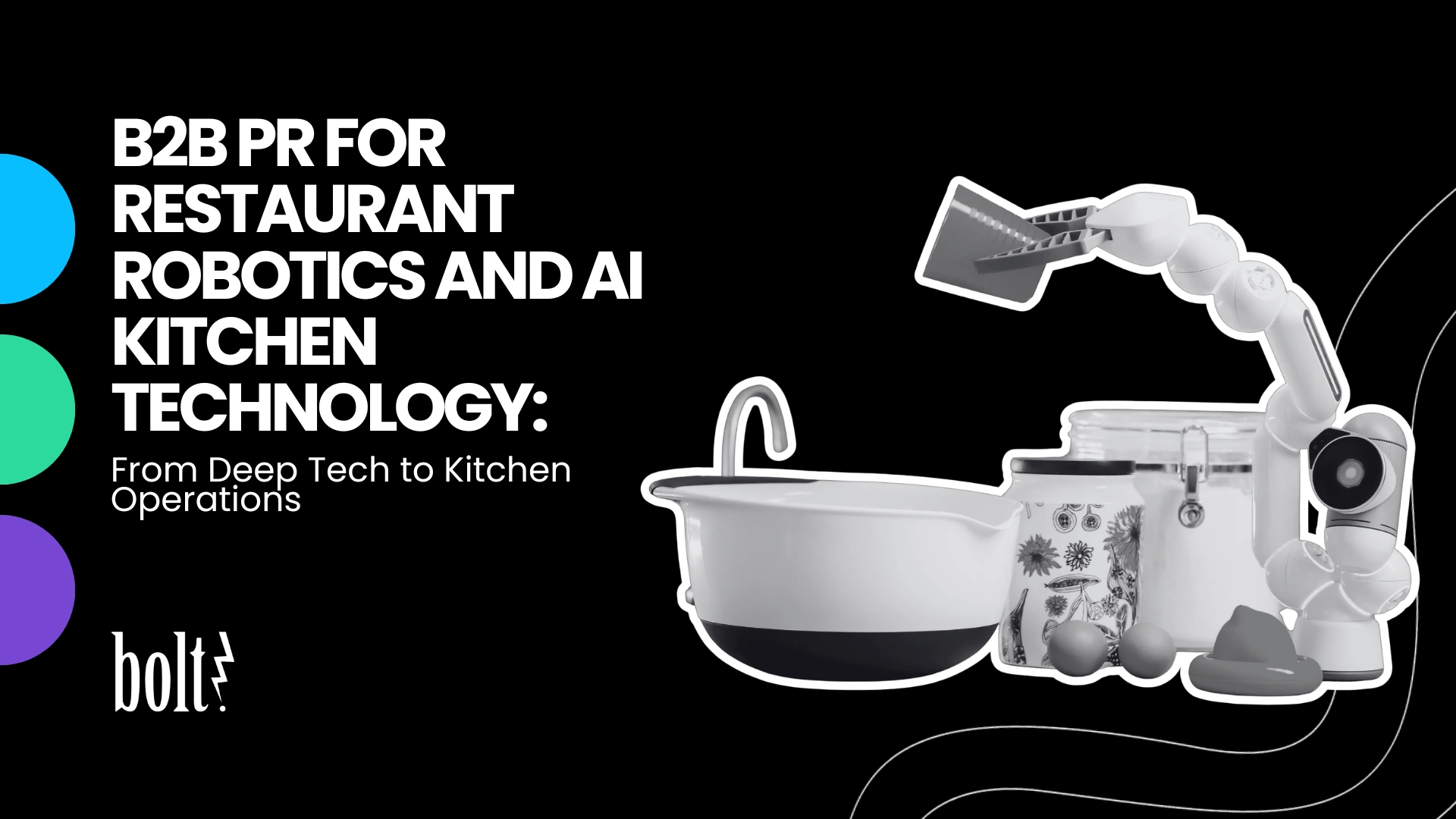
As restaurant owners and franchisees face persistent labor challenges and rising food costs, the demand for automation has shifted from a futuristic concept to an operational necessity. However, for B2B hardware startups, engineering the next generation of automated fry stations, AI-driven inventory systems, and robotic prep tables, a major hurdle remains: translating complex engineering specs into value propositions that a busy restaurateur actually cares about.
At Bolt PR, the team specializes in bridging the gap between deep tech development and real-world hospitality operations. To capture the attention of enterprise brands and multi-unit franchisees, tech providers must shift their messaging from how the machine works to how it saves the business money, time, and stress.
Here is how B2B hospitality brands can leverage PR and marketing to turn cutting-edge robotics into must-have kitchen investments.
Franchisees do not buy technology because they love engineering; they buy it because they have open shifts they cannot fill. According to data from the National Restaurant Association, the vast majority of operators still struggle with staffing shortages and high turnover rates. Your PR strategy should position your technology not as a replacement for human workers, but as a reliable tool that stabilizes kitchen workflows.
When crafting press releases, pitch angles, and blog content, focus heavily on operational metrics. Instead of highlighting the degrees of freedom in a robotic arm, highlight how the machine reduces peak-hour ticket times or cuts down training times for new staff. Frame your product as an operational relief valve.
Restaurant margins are notoriously thin, making operators inherently risk-averse when it comes to capital expenditures. B2B tech brands must back up their marketing claims with hard, transparent data.
To capture organic interest from restaurant decision-makers, your digital content strategy must align with high-intent B2B search queries. Operators look for practical solutions to specific problems.
An effective content program utilizes targeted search optimization by creating resource hubs around terms like "restaurant tech PR," "marketing kitchen robotics," and "B2B hospitality software." By publishing deeply educational articles that solve operational questions, your brand becomes a trusted authority long before a formal sales call is ever booked.
In the hospitality tech sector, third-party validation is everything. A brilliant demo video shot in a sterile engineering lab will never carry the same weight as a video of your robot working seamlessly alongside a line cook in a high-volume quick-service kitchen.
Seek out media opportunities that highlight real-world deployments. Pitching feature stories to key industry publications like Nation's Restaurant News or QSR Magazine that focus on the human element, how a specific franchisee integrated your technology to improve employee retention or customer satisfaction, creates an authentic narrative that resonates across the industry.
Successfully launching and scaling a restaurant robotics brand requires a partner that understands both the underlying technology stack and the high-pressure environment of a commercial kitchen. Because the path from deep tech engineering to a franchisee's portfolio requires both specialized industry positioning and extensive media reach, working with a generalist firm often yields minimal traction.
Bolt PR combines deep B2B technology experience with an extensive history in restaurant, franchise, and hospitality marketing. By integrating earned media relations, digital content strategy, and hyper-targeted search optimization, the senior-led team at Bolt PR ensures that your innovation becomes highly discoverable to the exact operators looking to automate their kitchens. From managing high-profile product rollouts to building sustained executive thought leadership, Bolt PR helps kitchen tech brands establish lasting market authority and convert engineering innovation into commercial adoption.
Restaurant tech PR is a specialized public relations strategy tailored for companies providing software, hardware, robotics, and AI solutions to the hospitality industry. It focuses on translating complex technical architecture into business-oriented narratives that appeal to restaurant owners, franchisees, corporate executives, and industry investors.
Many deep-tech startups fall into the trap of over-indexing on technical specifications, engineering milestones, and software capabilities. While investors appreciate these details, restaurant operators focus heavily on day-to-day utility, such as ease of cleaning, speed of service, training simple workflows, and direct labor cost reduction.
Brands should utilize clean, data-backed case studies developed in partnership with early-adopter kitchens. Highlighting verifiable metrics such as, a specific percentage decrease in food waste, a reduction in peak-hour ticket times, or concrete numbers around energy efficiency, builds the financial confidence risk-averse franchisees require before making a capital investment.
To reach franchise buyers and executive decision-makers, tech brands should prioritize trade publications like Nation's Restaurant News, QSR Magazine, Modern Restaurant Management, and Fast Casual. Additionally, broad business and technology trades like TechCrunch or Forbes are essential for driving investor interest and visibility during funding rounds.
Modern buyers conduct extensive independent research before contacting a sales team. By creating optimized blog posts, whitepapers, and guides around high-intent keywords like, "B2B hospitality software" and "marketing kitchen robotics," brands capture prospective buyers at the exact moment they are looking for solutions to their labor and operational challenges.

Not sure where to start?
Contact our team to start the conversation around a customized marketing campaign dedicated to your personalized business goals. From PR to content creation and digital marketing, you tell us how far you want to take your brand, and we’ll do the rest.
We can’t wait to hear from you!




.png)


