Thank you! Your submission has been received!
Oops! Something went wrong while submitting the form.

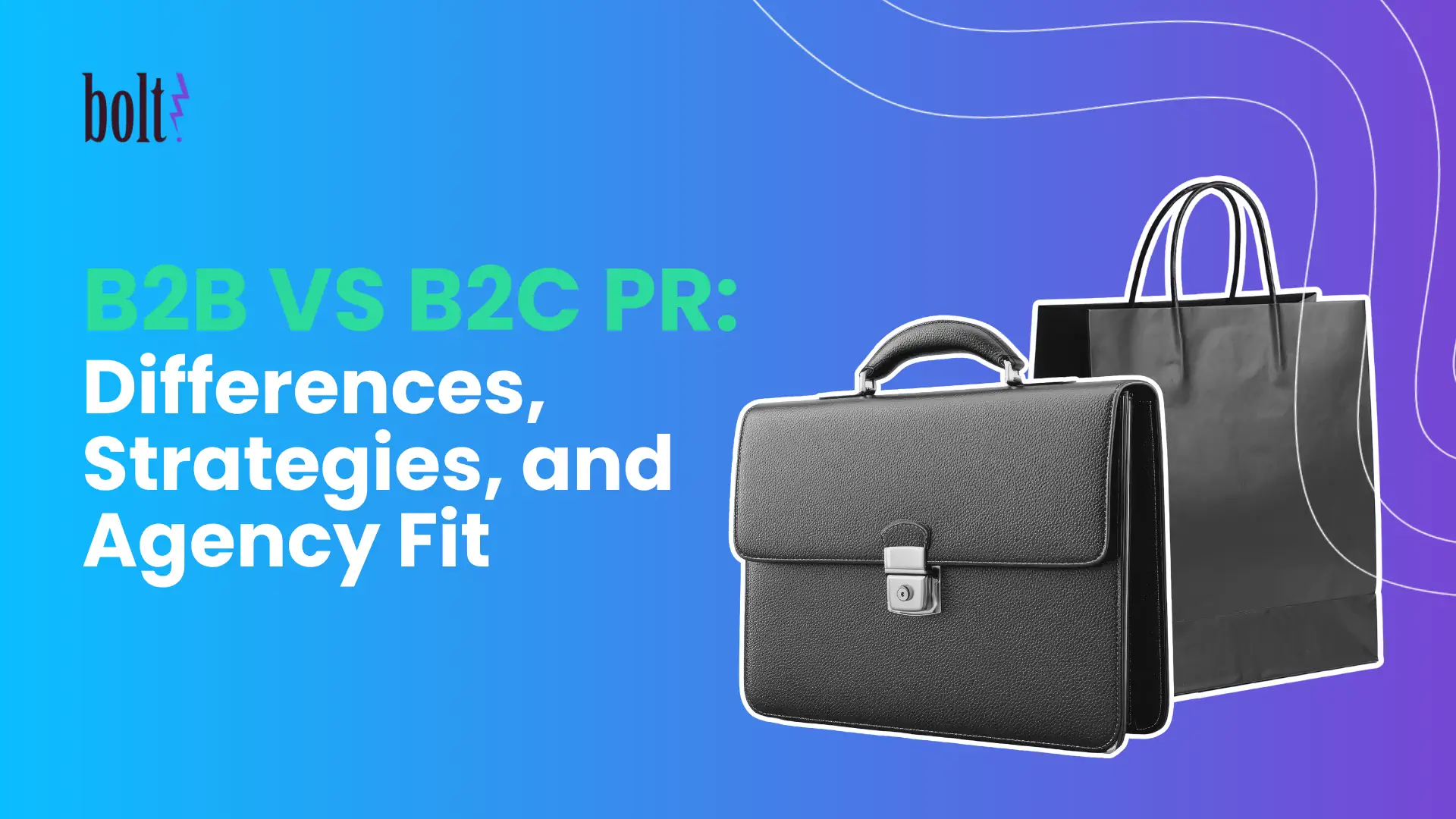
B2B PR and B2C PR differ in who they reach, how they persuade, and how results show up. B2B focuses on organizational decision-makers with thought leadership and ROI-driven proof over long sales cycles. B2C targets individual consumers with emotional storytelling, social influence, and rapid purchase triggers. Choosing the right approach aligns your program to buying dynamics, channels, and KPIs.
This comparison clarifies the core differences and the strategies that win in each arena. You will see how audience, message, media, and measurement shift between B2B and B2C. With verified data points, real-world examples, and client success, here’s a guide to learning what the right fit for your brand is.
B2B PR builds visibility, credibility, and understanding among business decision-makers. Programs educate buyers on problem-solution fit, mitigate perceived risk, and earn trust across a complex buying committee. Core tactics include executive thought leadership, trade media relations, analyst briefings, and industry speaking opportunities.
Average B2B software cycles often run 3 to 6 months in mid-market and 9 to 18 months in enterprise. Data shows that buying cycles have lengthened by ~54 days in recent years. Knowing that there are long buying cycles, it’s key to sustain always-on momentum through media relations in trade and business outlets and on LinkedIn.
The payoff is material. Recent research found that 67% of executives say presence in trade media directly influences sales and revenue growth. B2B PR works by sustaining expertise-driven narratives across specialized channels over months, not days, to influence multi-stakeholder decisions and measurable pipeline outcomes.
B2C PR targets individual consumers to build awareness, affinity, and action through emotionally resonant stories. Programs prioritize consumer media, influencers, social video, and lifestyle moments to drive discovery and purchase.
Decisions are faster than in B2B. According to recent data, an estimated 95% of purchasing decisions are made subconsciously. That is why compelling creative, social proof, and community amplify results. Social is central, and research indicates that 92% of PR pros say social media has transformed communications strategies. Creator partnerships move the needle, with data finding that 64% of consumers are more willing to buy when a brand partners with their favorite influencers.
Bolt specializes in consumer brands launching services or products with integrated PR and influencer programs that deliver significant national and regional coverage, high-impact creator content, and measurable engagement that can support sales.
B2C PR drives immediate visibility and conversion through consumer press, creators, and culture-led storytelling that taps fast-moving, emotion-first decisions.
Audience composition diverges. B2B buyers are committees that include executives, finance, procurement, and technical evaluators. B2C buyers are individuals or households motivated by personal benefit. This changes tone, proof, and channel.
Messaging shifts accordingly. B2B emphasizes risk reduction, ROI, and process improvement, typically proven with data, expert POVs, and customer outcomes. Research shows that thought leadership can even reduce the need for brand familiarity, with 53% of B2B decision-makers saying strong thought leadership makes brand recognition matter less. B2C leans into lifestyle, identity, and social validation, reinforced by the reality that Publicize estimates 95% of purchasing decisions are subconscious.
For example, a B2B software release unpacks how a client cut operational costs by 30%, while a consumer brand shares a customer’s story of achieving a personal goal. Both are emotional, but the triggers differ. B2B prioritizes reassurance and outcomes; B2C prioritizes belonging and aspiration.
B2B persuades groups with evidence and expertise, while B2C persuades individuals with identity, aspiration, and social proof.
Winning B2B strategies include executive thought leadership, data-driven bylines, analyst relations, webinars, whitepapers, and category POVs that help buyers make sense of change. Thought leadership is a force multiplier with research showing 53% of decision-makers say brand recognition matters less when thought leadership is strong, and 95% of hidden buyers say quality thought leadership makes them more open to outreach.
Winning B2C strategies center on audience reach and advocacy: consumer media pitching, creator partnerships, experiential moments, product seeding, and user-generated content. Words + Pixels reports that creator credibility matters, with 64% of consumers more willing to buy when brands partner with their favorite influencers.
B2B favors specialized media, otherwise known as trade publications. Trade coverage correlates with revenue influence for 67% of executives, according to recent data. Analyst relations with firms like Gartner, Forrester, or IDC deepen credibility with enterprise buyers. Social distribution concentrates on LinkedIn, where Axonn reports that 4 in 5 users are decision-makers.
B2C prioritizes high-reach consumer outlets and creator ecosystems. Think USA Today, Vogue, and viral social platforms. Social is now foundational across PR, with research reporting that 92% of PR pros say it has transformed communications. Journalists are there too, with 67% using social media to research stories.
Meet buyers where they seek proof. Use trade and LinkedIn to build expert authority in B2B, and consumer press plus creators to scale reach in B2C.
B2B PR ties to long-cycle outcomes. Use multi-touch attribution to connect trade coverage, executive bylines, and LinkedIn engagement with pipeline movements. Track share of voice in category media, referral traffic from placements, and lead quality from content offers. Research shows that many teams still struggle to map comms to the business success, with 44% of PR pros saying it is hard to align metrics to revenue or KPIs.
B2C PR emphasizes scale and sentiment. Measure reach, impressions, social engagement, creator content performance, website traffic spikes, branded search, and promotion-linked sales lift. Social listening and product review velocity signal momentum.
Tools can unify views. GA4 can attribute PR-assisted conversions through event tracking. CRM and marketing automation can correlate media touches with opportunity creation. Pair weekly activity metrics with quarterly business outcomes to avoid short-term bias.
B2B measures influence on pipeline and buyer confidence over time. B2C measures reach, sentiment, and near-term sales response.
Start with your model, buyer, and cycle length. If your sales cycle runs months to years and involves multiple stakeholders, prioritize sustained thought leadership, trade media, and analyst relations. If you sell fast-moving consumer goods with short paths to purchase, emphasize consumer press, creator partnerships, and social commerce moments.
Hybrid models need integrated plans. A weather data company sells forecasting platforms to aviation and energy buyers while operating a consumer weather app. That requires parallel motions: B2B programs that educate enterprise stakeholders and B2C programs that build daily habit and advocacy.
Use practical criteria to choose the mix:
Align PR to how your customer actually buys. Use hybrid roadmaps when you serve both enterprises and consumers.
Bolt designs senior-led, integrated programs that map to your brand’s growth goals, category dynamics, and sales cycle. In B2B, we build executive thought leadership and specialized media engines that convert visibility into opportunity. In consumer categories, we blend media, creators, and experiences to drive awareness and trial. A recent consumer launch delivered significant national and regional coverage and high-impact influencer content that expanded footprint. Whether you need enterprise credibility or consumer buzz, Bolt pairs creativity with measurable impact. Let’s connect to tailor a roadmap to your audience, channels, and KPIs.
Generally they require different playbooks because audiences and cycles differ. Hybrid brands should integrate both. Social platforms overlap, but content and proof points should align to buyer motivations.
It builds visibility, credibility, and trust with decision-makers through trade media, analyst relations, executive thought leadership, and LinkedIn distribution. According to Edelman, strong thought leadership can even offset brand familiarity for 53% of buyers.
Track reach, impressions, social engagement, sentiment, and sales lift tied to campaigns. Creator impact is a lever, with research reporting that 64% of consumers are more willing to buy when brands partner with favored influencers.
Prioritize LinkedIn as four out of five users hold decision-making roles. Use it with trade coverage and executive bylines to build consistent demand.
Distinct audiences and timelines demand distinct programs. Hybrid brands should plan parallel tracks with shared narrative guardrails.
B2B and B2C PR succeed for different reasons. B2B wins by sustaining authority with decision-makers, using thought leadership, trade media, and analyst relations to influence long, complex cycles. B2C wins by building emotional connection at scale with consumer press, creators, and culture-driving content. Measurement must match the motion, from multi-touch attribution and SOV for B2B to reach, sentiment, and sales response for B2C. If you are weighing your path, start with buyer makeup, cycle length, and the channels they trust. Then choose the tactics and KPIs that fit.

Not sure where to start?
Contact our team to start the conversation around a customized marketing campaign dedicated to your personalized business goals. From PR to content creation and digital marketing, you tell us how far you want to take your brand, and we’ll do the rest.
We can’t wait to hear from you!



.png)


